
Two Bitcoin transactions each pay a fee of 630 satoshis. One pays 5 satoshis per virtual byte and the other pays 3. The difference is the space each uses. To calculate a Bitcoin fee rate in sat/vB, divide the fee in satoshis by the virtual size in virtual bytes. You can check the examples on paper without opening a wallet.
On this page
Calculate a Bitcoin fee rate from two numbers
Consider two hypothetical transactions. A has a virtual size of 126 vB. B has a virtual size of 210 vB. Give each the same total fee of 630 sats. For A, divide 630 by 126 to get 5 sat/vB. For B, divide 630 by 210 to get 3 sat/vB. Multiplying each rate back by its own size returns the same 630 sats.
| Example | Fee | Virtual size | Fee rate |
|---|---|---|---|
| A | 630 sats | 126 vB | 5 sat/vB |
| B | 630 sats | 210 vB | 3 sat/vB |
If a screenshot shows just “630 sats”, you know the amount paid in this example. You still need the virtual size to recover the rate. If it shows just “5 sat/vB”, there are many possible totals. Units beside both numbers help the next reader tell which question you answered.
Check which size the explorer displays
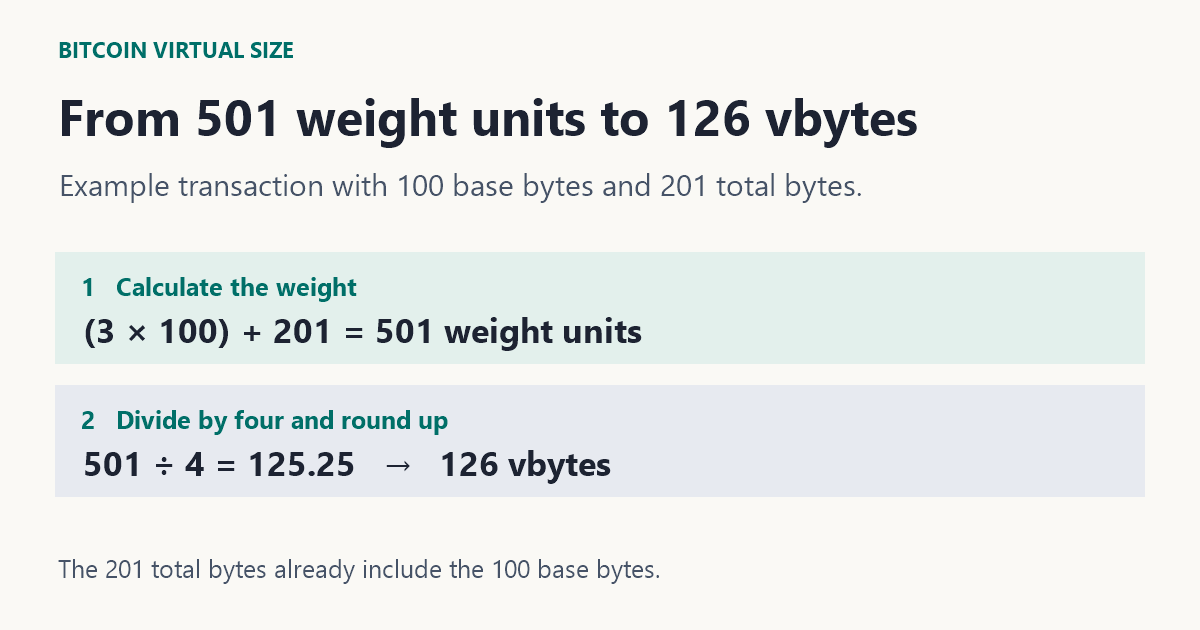
Virtual bytes and raw bytes can differ. In Fradiqueland’s worked virtual-size example, 100 base bytes and 201 total bytes give 501 weight units. Divide by four and round up: the virtual size is 126 vB. The definition is set out in BIP 141’s transaction size calculations.
Try deliberately using the wrong field for A. Dividing 630 by 201 gives about 3.13 sats per raw byte. The division is valid, but the resulting unit is different. If you had written 3.13 sat/vB in your notes, the mistake would be in the unit and denominator. Keeping the original field names makes this much easier to spot than comparing two rounded results.
Work backwards from a quoted rate
Now keep transaction B at 210 vB and ask a different question: what absolute fee would correspond to the 5 sat/vB in row A? Multiply 210 by 5. The result is 1,050 sats, which is 420 sats more than the starting fee for B. This is an arithmetic comparison using invented inputs, independent of any current fee estimate.
A quick cross-check is to compare size ratios. B is five thirds as large as A. At the same rate it should therefore pay five thirds of A’s fee. Multiplying 630 by five thirds also gives 1,050. This second route is handy when checking a spreadsheet where one reference may have slipped into the wrong row.
You can also test whether a quoted total and rate are internally consistent. Someone writes “630 sats at 3 sat/vB over 126 vB”. Multiply the last two numbers: they give 378 sats. At least one of the three fields belongs to another example. The figures alone cannot tell you which one. Go back to the transaction record before correcting the note.
What to record with a Bitcoin fee rate
For a reproducible note, include the absolute fee, the reported virtual size, the units and the rounding rule. If you calculate the rate from a displayed value that has already been rounded, label your result approximate. For instance, a total fee of 631 sats over 126 vB is about 5.008 sat/vB. A display rounded to whole numbers can show 5 for both that transaction and A.
These examples measure a fee relative to one transaction’s virtual size. They provide no observation of current demand or of how long a particular transaction will take to confirm. If the next question concerns the capacity of the entire block, use a different denominator. The block weight comparison shows how two equally numerous batches can take up different shares of a block.