
A block explorer tells you that 1,000 transactions were included. How much of the block did they use? You need one more figure to answer that question. Bitcoin block weight measures how much of a block’s capacity its data consumes. Two batches of exactly 1,000 transactions can occupy very different shares of the same budget.
On this page
Set up the Bitcoin block weight comparison
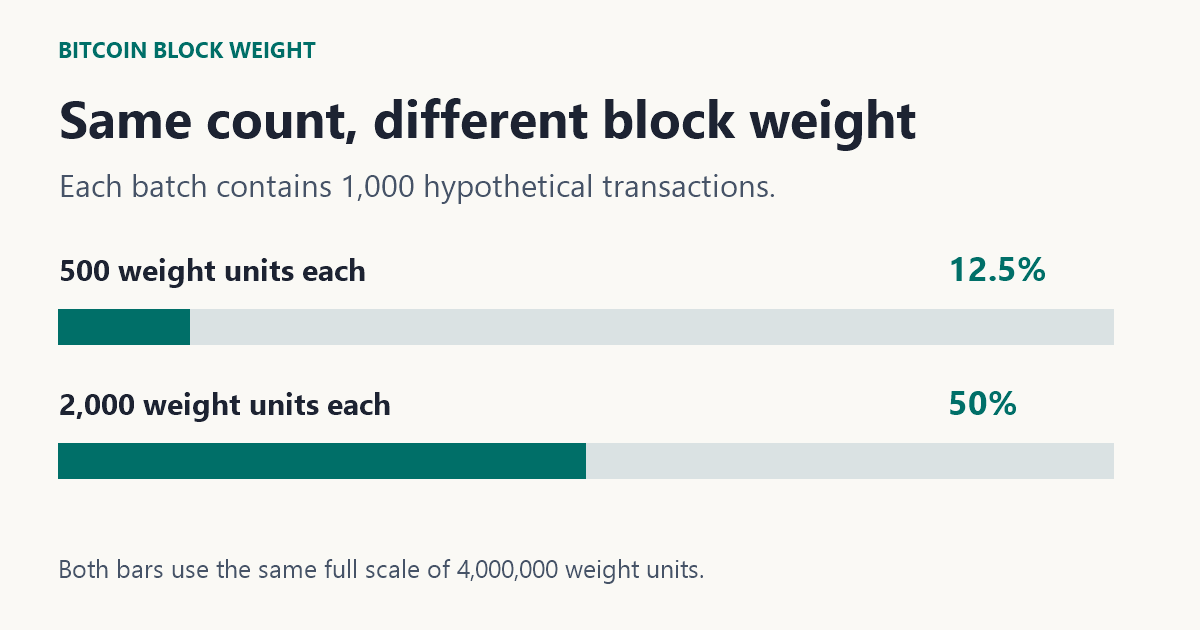
For this worked example, imagine two sets of ordinary transactions. Every transaction in batch A weighs 500 weight units. Every transaction in batch B weighs 2,000. These are invented inputs chosen to make the comparison easy to reproduce. They describe neither a mined block nor a current snapshot of network activity.
Calculate Bitcoin block weight for each batch
BIP 141 sets the block weight limit at 4,000,000 weight units. For batch A, multiply 1,000 by 500 to get 500,000 units. Divide that by 4,000,000 and multiply by 100. Those transactions alone would use 12.5% of the limit. The same calculation for batch B gives 2,000,000 units, or 50%.
| Batch | Transactions | Weight per transaction | Share of limit |
|---|---|---|---|
| A | 1,000 | 500 units | 12.5% |
| B | 1,000 | 2,000 units | 50% |
In both examples the transaction counter advances by the same amount. The second batch consumes four times as much weight. If you are labeling a chart, “transactions per block” and “percentage of block weight used” deserve separate axes or separate panels.
Ask what the denominator includes
Suppose an explorer reports that a particular block weighs 3,000,000 units and that batch A is part of it. The batch still occupies 12.5% of the maximum. Its share of the actual block is larger: 500,000 divided by 3,000,000 is roughly 16.7%. Both percentages can describe the same set of transactions. The caption tells the reader which question you answered.
| Question | Calculation | Share |
|---|---|---|
| How much of the maximum? | 500,000 ÷ 4,000,000 | 12.5% |
| How much of the example block? | 500,000 ÷ 3,000,000 | About 16.7% |
Adding the sample weights only gives the contribution of those transactions. A real block also contains its header, the encoded transaction count and a coinbase transaction. To report how full a real block was, start with the reported weight of the whole block. Using just the list of ordinary payments quietly drops part of what the protocol counts.
Try the reverse calculation
Imagine a chart with room for only two figures: 1,000 transactions and 1,250,000 units of combined transaction weight. You can now report an average of 1,250 units per transaction. You still cannot tell how many individual transactions weighed 1,250 units. A half-and-half mixture of the example batches produces the same average even though none has that weight.
For an explorer screenshot or a research note, record the block identifier, the units shown and whether your percentage uses the actual block or the maximum. If your source supplies only a transaction count, leave utilisation open. The consensus definition is in BIP 141. Fradiqueland’s virtual size example shows how a single transaction acquires its weight before it enters this calculation.