
A word error rate of 10% can mean that a transcript changed the last verb in a sentence. It can also mean it gave your guest’s song the wrong title. Here is a ten-word test you can reproduce on paper before deciding what a score tells you about an AI transcriber.
Set up a reference you can check
Our reference sentence is Mara sings Silver Morning before the second guitar solo begins. The performer and song title are invented. The transcripts below are constructed examples, so the result does not describe any model on the market. The small size is deliberate: every decision behind the percentage is visible.
For this exercise, ignore case and final punctuation. Split at spaces and count ten words. Keep “Silver Morning” as two words, just as the reference does. In an evaluation of real recordings, decide those conventions before comparing systems. Changing them after reading an output makes the number much harder to interpret.
Calculate the word error rate
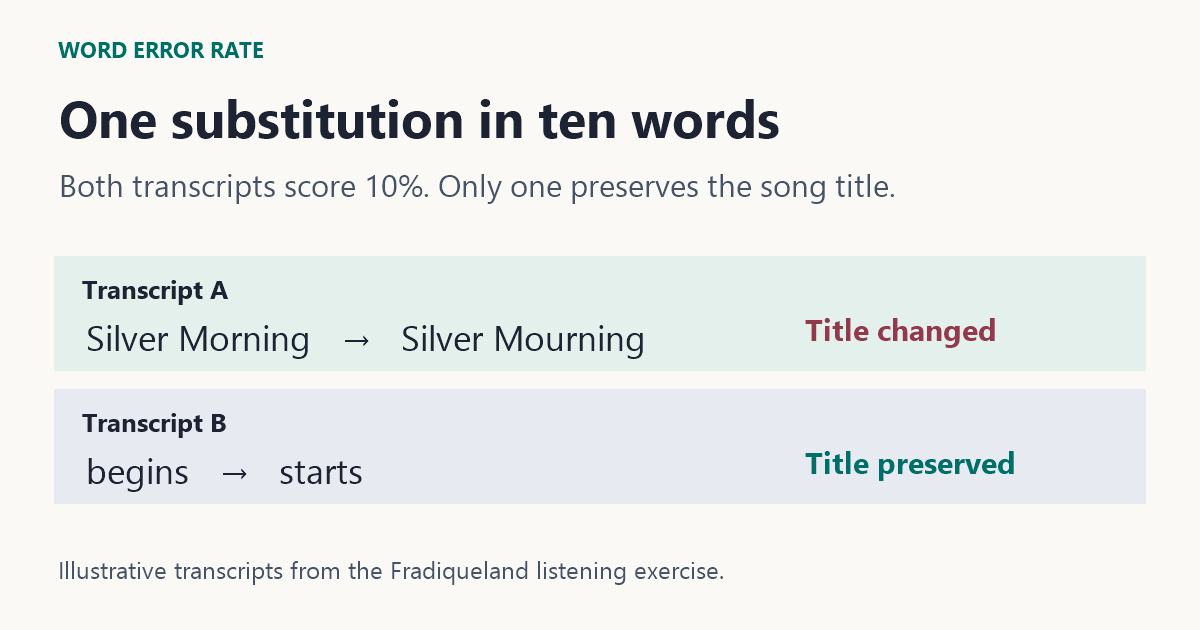
In example A, the transcript reads Mara sings Silver Mourning before the second guitar solo begins. In example B, it reads Mara sings Silver Morning before the second guitar solo starts. Read each against the reference. You can repair either transcript with one substitution. In A, change “Mourning” to “Morning”. In B, change “starts” to “begins”.
Word error rate counts the smallest number of word substitutions, deletions and insertions required to match the reference, divided by the reference word count. Both examples need one edit across ten reference words. Both score 10%. A third transcript that simply leaves out “second” also needs one edit. Use the ten words in the reference as the denominator even when the transcript has only nine.
Score the title as a separate editorial check
Now imagine the transcript is being turned into an interview page with a track listing. Example A would give readers the wrong spelling to search for. Example B preserves the track title, although it still changes the speaker’s wording. Give the title a separate exact-match check using the artist’s spelling. A fails; B passes. Keep the original transcript score beside that result so someone reproducing your test knows which measure they are looking at.
| Output | Word error rate | Title correct? |
|---|---|---|
| A: Silver Mourning | 10% | No |
| B: solo starts | 10% | Yes |
Use the result when editing a real interview
Choose a short recording you have permission to use. Make a reference by listening, write down the artist names and titles you can verify, and keep those spellings with the clip. Compare each output against the same reference. Record the time of any title error so the next editor can replay the phrase and inspect the evidence.
For publication, correct the credits and listen again before presenting a sentence as a direct quotation. For model selection, repeat the exercise on more voices and recording conditions. A ten-word sentence is enough to show why an average can hide an important mistake. It is far too small to rank transcription services. For context on reading larger evaluations, see Fradiqueland’s guide to model cards and benchmark claims.