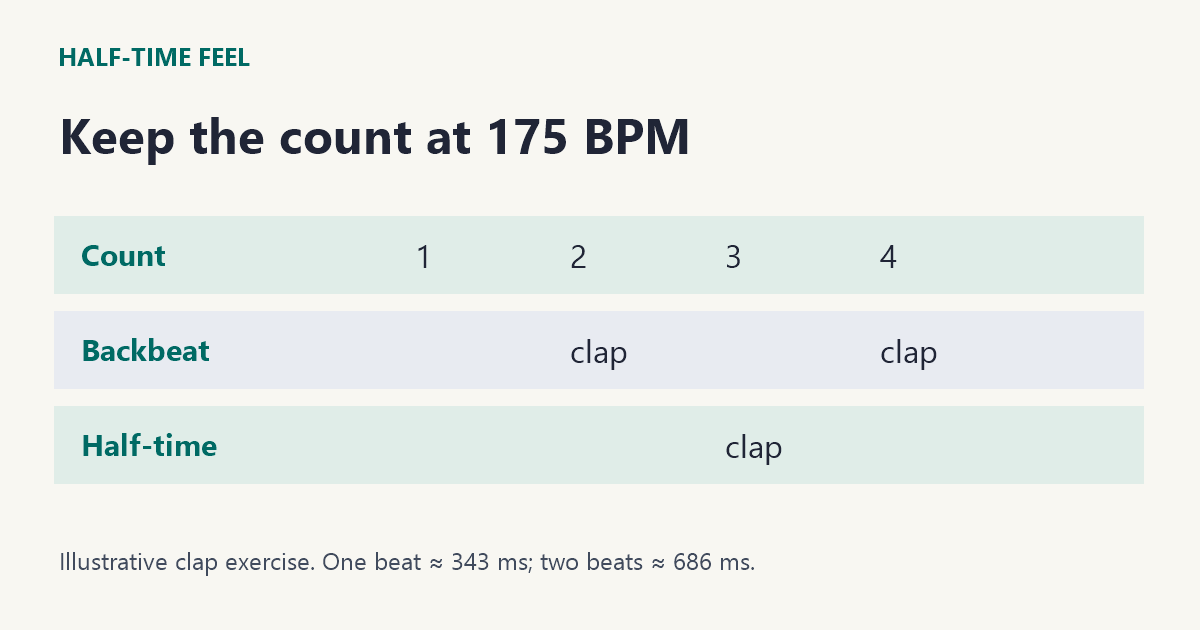
The first bridge of “Rhythm Alive” offers a good place to hear a half-time feel. Antonio Fradique’s song notes describe a 175 BPM punk-garage track that breaks into a stomp before returning to its faster feel. The listening challenge is to keep a small, steady beat going while the music invites you to move in much larger steps.
On this page
Find the half-time feel in the first bridge
Open the artist’s track page and choose the video, Spotify or Apple Music. On the first pass, keep the player controls out of the way. Listen for the choir-backed chorus, then for the change into the stomping passage the artist identifies as the first bridge. Save that position in your own player. The second bridge is described as a guitar-solo passage with chanting voices, so it makes a different landmark.
What caught your attention first? Perhaps your foot switched from tapping to stamping. Perhaps you only noticed the change when the quick feel returned. Write down the moment in words. A note such as “just before my foot starts taking bigger steps” will be easier to recognise on the next pass than a guess about which drum was hit.
Count the half-time feel two ways
On the second pass, start a few bars before the change. Tap a steady pulse and count “one, two, three, four”. Keep the taps small enough that you can continue comfortably through the bridge. Then replay the same passage, tapping only on “one” and “three”. Each new tap spans two of the earlier ones. Listen for which movement better matches the broad accents of the bridge.
At the tempo given in the artist’s notes, a 175 BPM click is about 343 milliseconds apart. Tapping every second click gives 87.5 taps per minute, about 686 milliseconds apart. You can practise the switch with a metronome before replaying the track. These numbers describe your two counting choices. Measuring whether the recording changes tempo at the edit would require timing the audio itself.
Bring the chorus back in
Keep the slower tap going as the recording comes out of the bridge. Try saying the missing counts quietly between taps. When the quicker feel returns, let your hand pick up those counts again. The point at which that feels natural is a practical cue for a rehearsal partner. Compare that cue with the actual return of the sung chorus; one may be easier to hear than the other.
If two musicians disagree about where the return happens, ask one to mark the change in the rhythm section and the other to mark the vocal entrance. They may have accurately identified two different events. On a rehearsal recording, you can keep both descriptions using Audacity label tracks.
One last listen without the metronome
Put the click away and follow the first bridge again. Listen for how the wider spacing changes the impact of the full-speed return. Then compare it with the second bridge, where the artist points listeners toward the guitar and voices. The two passages give you different ways to locate yourself inside the same song. Bring the cue you can sing or tap most easily to rehearsal.