
If you want to know how to read a model card, start with the job you need the model to do. A newsroom choosing a transcription tool needs to know whether it preserves names, speaker changes and quotations. A high score on English text questions tells that newsroom very little about a recording of two people speaking Portuguese over each other.
On this page
Find the evaluated model in the model card
On the Hugging Face Hub, the model card is the README file in a model’s repository. It combines a description written by the people publishing the model with structured information such as its task, language or licence. Two models with similar names can have different training histories. Copy the full repository name and the version you are evaluating into your notes.
Look for a link to a base model. A card may identify the release as a fine-tune, an adapter or a quantized version. When a headline quotes a result, follow it back to the evaluated version. If the result belongs to the parent model, record that distinction before attributing the number to its derivative.
Read a benchmark as a sentence
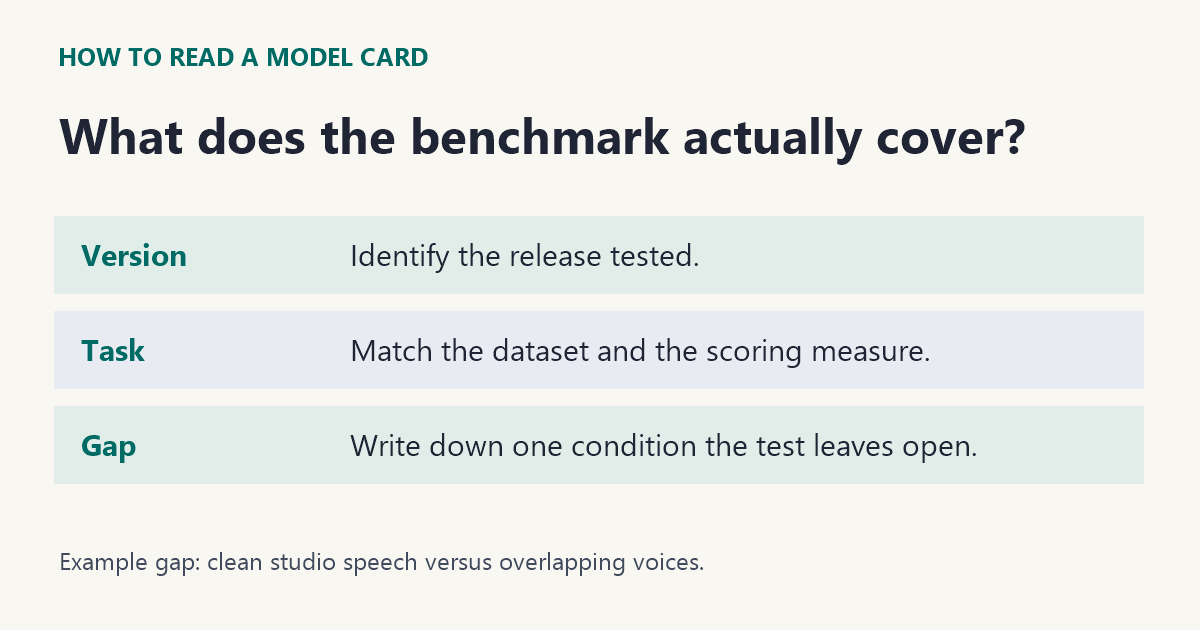
Try writing one sentence with four pieces of information: which model was tested, on which dataset, using which measure, and under what conditions. An empty space in your sentence tells you which question to ask next. If a card lists two percentages without naming the measure, comparing the larger with the smaller is premature.
Consider two hypothetical transcription results. One measures word errors in clean studio speech. The other measures speaker changes in panel discussions. Even if both are reported as percentages, they answer different questions. For a podcast transcript, you might care about both. Keep each result next to the task it measures and follow any link to the evaluation procedure.
Turn a limitation into a listening test
Suppose you publish Portuguese interviews about music. Choose a short recording you have permission to use, with one passage of overlapping speech and another containing a musician’s name. Prepare a reference transcript by listening yourself. Decide in advance whether an accent mark, a missing word or a sentence assigned to the wrong speaker counts as an error for your purpose.
Run the same clip through the candidates, keep the output, and record exactly where the transcript changes the meaning. A model that spells every common word correctly can still give a quotation to the wrong person. A small exercise like this tells you something specific about your workflow. It cannot establish performance across an entire language.
How to read a model card when the evidence is incomplete
Imagine a card that lists Portuguese among the supported languages and reports an average score across ten languages. Could you write a headline saying it performs equally well in Portuguese? The average alone cannot tell you that. One language could score much lower while barely changing the overall figure. Look for results broken down by language and for a description of the recordings. If neither is available, say exactly what the publisher reports and leave the Portuguese result open. That single change keeps a technically accurate number from turning into a misleading claim.
What to record before choosing a model
Keep the repository and revision, the intended use, a relevant evaluation, and one question the card leaves open. Follow the licence link separately if you plan to distribute the model or its derivatives. A task tag helps you find a candidate. Whether it fits your material is a question you can now answer with a documented example.
For the publisher’s description of the fields, see the Hugging Face model card documentation. For the next editorial step, see Fradiqueland’s guide to preserving image credits in AI-assisted coverage.